
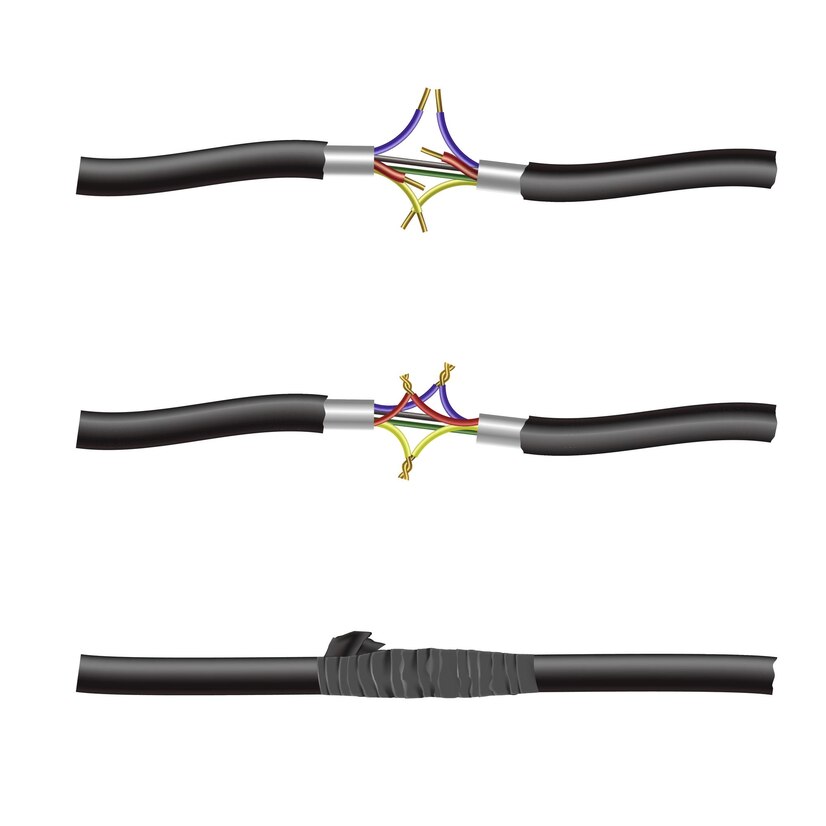
A cable joint may look like a small part of an electrical installation, but it has a big job to do. It must keep the conductors properly connected while protecting the joint from moisture, mechanical stress, and the surrounding environment. If the wrong method is used, or the joint is not installed properly, the problem may not show up straight away. Knowing the different Cable Jointing Types helps make that choice easier.
Yamuna Power & Infrastructure Ltd provides cable jointing solutions for different cable applications, with options such as heat shrink, cold shrink, and pre-moulded systems. The right choice depends on the cable, voltage, and conditions where the joint will be installed.
What Is Cable Jointing?
Cable jointing is the process of connecting two cable sections while restoring the electrical insulation, shielding, and mechanical protection around the connection.
A cable joint does more than connect conductors. The jointing system also needs to recreate the protective layers that were removed while preparing the cable. Depending on the cable and application, this can involve insulation, screening, stress control, sealing and earth continuity.
For long underground cable runs, jointing becomes especially useful because cables often need to be installed in sections rather than as one continuous length. Yamuna Power notes that cable joints can be used for both similar cable connections, such as XLPE to XLPE, and transition connections such as XLPE to PILC.
What Are the Main Cable Jointing Types?
Cable joints can be grouped by the way they are installed and the type of cable connection they are designed to make. Common options include heat shrink, cold shrink, pre-moulded, straight-through, and transition joints.
1. Heat Shrink Cable Joints
Heat shrink joints use polymeric components that shrink when heat is applied. Once the components are placed in the required position, they tighten around the cable and form the joint.
They help restore insulation and provide protection against moisture and outside exposure. Yamuna Power offers heat shrink jointing systems from 1.1 kV onwards, including straight-through and transition options for different cable types.
One practical advantage is the familiar installation process. Heat is used to shrink the components into place, so the installer needs to follow the recommended heating procedure carefully.
2. Cold Shrink Cable Joints
Cold shrink joints take a different approach. The joint components are supplied in an expanded state and contract around the cable when the supporting material is removed. No external heat is needed.
That can be useful at sites where using a heat source is inconvenient. Depending on the design, these joints can also provide weather protection, UV resistance, and stress control. Yamuna Power includes cold shrink systems in its range for different cable configurations and voltage applications.
3. Pre-moulded Cable Joints
Pre-moulded joints come in a shaped form that is manufactured before the installation begins. The joint body is designed to fit around the prepared cable and provide the required insulation and stress control.
They are used where controlled installation and consistent electrical performance are required. Yamuna Power offers pre-moulded joints for 11 kV, 22 kV and 33 kV XLPE cable systems, with applications that include manholes and tunnels.
4. Straight Through Joints
A straight-through joint connects two cable sections of the same or compatible construction. An XLPE cable, for example, may be joined to another XLPE cable with the required specifications.
The purpose is simple. It allows a cable route to be extended or repaired without compromising the electrical connection between the two sections.
5. Transition Joints
Transition joints are used when two different types of cables have to be connected. XLPE to PILC is one example.
This type of connection needs more attention because the two cables do not have the same construction or insulation system. The joint therefore has to be selected specifically for the cable combination and its operating conditions.
What Is a Cable Jointing Kit?
A Cable Jointing Kit contains the components needed to complete a cable joint. What comes inside the kit depends on the cable, voltage, joint design and installation method.
For example, a heat shrink kit may contain:
- Heat shrink tubes
- Insulation components
- Stress control materials
- Conductive tapes or components
- Sealing mastics
- Metallic shielding
- Mechanical connectors or compression ferrules
- Earth continuity components
These parts are not included just for the sake of it. Each has a particular role. The connector joins the conductors, insulation components rebuild the electrical insulation, and sealing and shielding components help protect the finished joint.
How Do You Choose the Right Cable Jointing Kit?
The cable itself is a good starting point when choosing a Cable Jointing Kit. Looking only at the voltage rating can lead to the wrong selection.
A few details should be checked first.
Cable voltage: Make sure the kit is suitable for the system's operating voltage.
Cable type: XLPE, PILC, EPR, and PVC cables can require different jointing arrangements.
Number of cores: A single-core cable and a multicore cable will not use the same configuration.
Cable size: The conductor and insulation dimensions need to fall within the manufacturer's specified range.
Joint type: Check whether the job calls for a straight-through joint, transition joint, or another configuration.
Installation environment: A joint installed in a tunnel or manhole may face different conditions from one installed in an open outdoor location. Moisture and temperature changes also need to be considered.
Installation method: Heat shrink, cold shrink, and pre-moulded systems each have their own installation requirements.
Yamuna Power recommends looking at factors such as site conditions, operating parameters, voltage, and cable type before selecting the appropriate jointing system.
Why Installation Quality Matters
A good jointing kit is only part of the job. The way it is installed can have just as much impact on the finished connection.
The cable ends have to be prepared to the specified dimensions. Connectors need to be fitted correctly, while insulation, stress control, and sealing components must go into their intended positions. With heat shrink products, the application of heat also needs to be handled properly.
Moisture is another issue that should not be overlooked. If water gets into the joint during installation, or if the finished seal is not adequate, the performance of the insulation can be affected over time.
That is why cable jointing is normally carried out by trained installers who follow the manufacturer's instructions and use the recommended tools and procedures.
Why Choose Yamuna Power for Cable Jointing Solutions?
Yamuna Power & Infrastructure Ltd offers cable jointing solutions based on heat shrink, cold shrink, and pre-moulded technologies. The range includes straight-through and transition joints for different cable types and voltage applications.
Its published product information covers applications up to 72.5 kV for certain jointing products. The available options vary according to the cable construction and application.
For any project, it makes more sense to select the jointing system after checking the actual cable specifications and site conditions. Voltage is only one part of that decision.
Choose Reliable Cable Jointing Solutions for Your Project
Cable jointing is not a one-size-fits-all job. The cable construction, voltage, joint configuration, and installation environment all influence which solution is suitable. Getting those details right before installation can prevent compatibility issues later.
Yamuna Power & Infrastructure Ltd offers heat shrink, cold shrink, and pre-moulded jointing solutions for different cable applications. For project-specific requirements, reviewing the cable specifications and installation conditions with the technical team is the practical next step.
